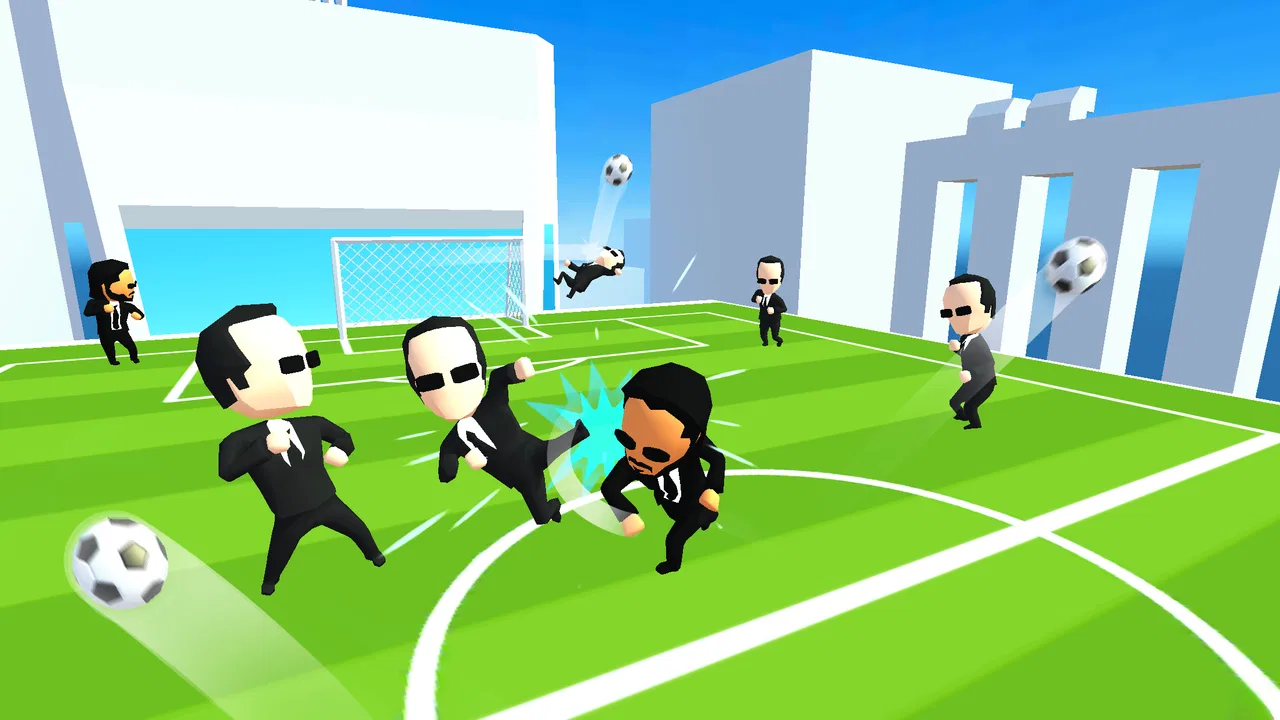
I, The One — Fun Fighting Game
- 4.3
- Rating
- 100.00M
- Installs
- Free
- Price

 Analysis by App-foxy
I, The One — Fun Fighting Game is the kind of action game I open when I want quick physical comedy rather than a deep competitive fighter. Its central appeal is immediate: move around an arena, strike opponents, and try to send every rival out of the fighting space. I found it easy to understand within a few moments, but the simple presentation hides a surprisingly important question: can you read the crowd, control your position, and choose the right moment to attack before someone else knocks you away?
That makes it a good fit for short breaks, casual sessions, and players who enjoy the satisfaction of pushing enemies into danger. It is not the game I would choose for a carefully balanced tournament experience or a story-led adventure. Instead, it works best as a compact mobile distraction built around movement, timing, and the amusing chaos of several fighters competing in a confined arena.
Developed by CASUAL AZUR GAMES, this free action game has reached over 100 million installs and holds a 4.3 average from around 311 thousand ratings. Those numbers make sense to me: the basic idea is instantly readable, the matches do not demand a long tutorial, and the exaggerated arena battles are easy to watch as well as play. The age rating is Everyone 10+, while optional in-app purchases range from $0.99 to $99.99 per item, so I would still approach the free download with a little spending awareness.
You May Also Like

 Blood Strike: 2.5 Anniversary
Blood Strike’s Loadouts Turn Every Drop Into a Tactical Gamble
A close look at Blood Strike’s custom loadouts: how fast access to signature weapons reshapes its battle royale rhythm, rewards preparation, and narrows the gap between fights.

 Pandora - Music & Podcasts
Pandora’s Music Is Easy to Start, but Harder to Recover
Pandora’s strength is its low-effort path from a seed to a station. Its weak spot is how much confidence it asks you to place in connection, setup, and quiet recovery.

 8 Ball Pool
 Is Built on Rivalries, Rematches, and Routine
A close look at the rivalries, rematches, shared routines, and unanswered safety questions that turn a quick pool match into a persistent mobile community.

 Samsung Music
’s Quiet Strength Is Playing What You Already Own
Its reach comes less from spectacle than from dependable access to a personal library. That simplicity is both the app’s strongest retention engine and its ceiling.

 AccuWeather: Weather Radar
AccuWeather Review: A Quick, Clear Forecast for Everyday Decisions
For everyday plans, the best forecast is the one you can understand quickly. AccuWeather makes rain timing, radar, and local conditions easy to act on, with a few trade-offs.

 Hill Climb Racing
Why Hill Climb Racing Still Turns Crashes Into One More Run
A tiny car, a bumpy hill and one more upgrade: Hill Climb Racing keeps resurfacing because its simple chaos makes every near-miss feel personal.
More From Our News Desk



Why the arena combat works so well
I enjoy how the arena turns a straightforward brawl into a small test of judgment: before I commit to a strike, I need to consider where the other fighters are and whether I’ll still have room to move afterward. That makes patience and awareness as useful as aggression, especially when the edges become dangerous. Next, I’ll look at which players are likely to appreciate that focused style—and who may be happier with a different kind of fighter.
A simple objective with room for judgment
The first thing I liked is that the goal stays clear. You are not memorizing a complicated move list or studying a large map. You are trying to remain in control while opponents attempt to do the same. That clarity is valuable on a phone because I can start a session without remembering a long chain of controls or a complicated set of rules.
However, “hit everyone” is not quite the whole strategy. Position matters constantly. If I rush toward the nearest fighter, I may leave myself open to an attack from another direction. If I stay too close to the edge, one mistake can turn a normal exchange into a quick defeat. The most useful habit I developed was to avoid treating every opponent as the immediate target. Sometimes the smarter move is to create space, watch two fighters collide, and attack when one of them is already poorly placed.
That small change in thinking gives the game more substance than its casual label suggests. The controls are approachable, but winning consistently depends on reading distance and choosing when not to swing. I would not call it a technical fighting game, yet it rewards a kind of simple arena awareness that keeps the matches from feeling completely automatic.
Why short sessions feel natural
I, The One — Fun Fighting Game is especially comfortable when I have only a few minutes available. A quick session can fit into a commute pause, a waiting room, or the gap before another task. I do not need to prepare a long campaign or commit to a lengthy match. That makes it more convenient than many traditional fighting games, which often ask me to learn several characters, understand elaborate systems, or spend more time building momentum.
The short-session design also makes failure easier to accept. When I make a poor approach and get knocked out, I am not losing a large amount of progress in a story. I can simply try again and adjust my opening movement. For me, that retry-friendly rhythm is one of the strongest reasons to keep the game installed.
There is a trade-off, though. Players who prefer long-term progression, narrative context, or a sense of building a fighter over many hours may find the repeated arena structure thin. The game’s appeal comes from the action itself, not from a large surrounding world. If the physical encounters stop feeling fresh to you, there may not be enough outside the core loop to compensate.
The best way to approach a crowded fight
My most useful practical tip is to think in terms of exits rather than targets. Before attacking, I try to notice which direction would leave me room to recover. A powerful-looking strike is less valuable if it places me beside the boundary with another fighter closing in. Keeping an open route behind or beside me often matters more than landing the first hit.
I also found it helpful to avoid constant movement. Running around without a plan can make the arena feel busy, but it does not necessarily improve my position. Short adjustments are easier to control than frantic changes of direction. When an opponent commits to an approach, waiting a moment can make their movement predictable and give me a better chance to respond.
Another useful trade-off is deciding whether to attack the strongest-looking threat or the opponent who is already vulnerable. The obvious target is not always the right target. A fighter near the edge may be a safer opportunity than a central opponent who still has plenty of room. This is a small tactical layer, but it gives each encounter a reason to pay attention instead of simply tapping as quickly as possible.
What separates it from ordinary mobile brawlers
Many mobile fighting games focus on collecting characters, following a story, or performing increasingly elaborate combinations. This one feels more direct. Its identity comes from the arena and the act of forcing rivals out of it. That makes the experience easier to pick up than a conventional fighter, but also narrower.
Compared with a traditional one-on-one fighting game, this is less about memorizing matchups and more about surviving a changing group situation. Compared with a physics-heavy party brawler, it feels more focused on the immediate push-and-strike objective than on elaborate environmental antics. I prefer it when I want a clean, self-contained burst of action, while I would choose a deeper fighter when I want practice, character mastery, and a more demanding competitive ceiling.
The distinction matters before downloading. The game is not trying to replace a console-style fighter on a touchscreen. Its strength is that it reduces the commitment required to have fun. I can understand the premise quickly and still make meaningful mistakes because of poor spacing or impatience.
Where the experience begins to wear thin
The biggest limitation is repetition. The core idea is enjoyable, but it is also tightly focused. Once the novelty of knocking opponents out of the arena becomes familiar, the experience depends heavily on whether the moment-to-moment encounters continue to entertain you. I enjoyed the first burst of experimentation more than the later stretches where I already understood the safest habits.
This is not a criticism of the basic design so much as a warning about expectations. A casual action game can be excellent at delivering a few minutes of fun without becoming a game I want to play continuously for an entire evening. I would recommend treating it as a pick-up-and-play option rather than expecting it to become a permanent main game.
The free-to-play structure is another point worth considering. The game costs nothing to install, which lowers the barrier to trying it, but optional purchases can reach $99.99 for an item. I would not spend automatically just because a purchase appears during play. Anyone who shares a device with children should also use the platform’s purchase controls, especially because the age rating allows a broad younger audience while the available purchase range is substantial.
Performance expectations should also be sensible. The current version is 3.72.04 and the listed minimum operating system is Android 7.0. That gives the game a wide potential device range, but an older phone can still feel less comfortable with fast touch interactions than a newer one. I would make sure the screen responds reliably and avoid playing in a way that leaves my fingers covering the most important part of the arena.
Small habits that make matches more enjoyable
I recommend beginning each session with observation instead of immediately trying to dominate. The opening moments reveal how crowded the arena is and which opponents are moving aggressively. That information helps me decide whether to press forward or keep a safer angle. It also prevents the common mistake of entering the center before I understand where the danger is coming from.
When I lose, I try to identify one specific cause rather than blaming the entire match. Was I too close to the boundary? Did I attack while another opponent was behind me? Did I chase a target that was not worth the risk? This approach makes retries more useful. Because the controls are simple, improvement comes less from learning a large command set and more from correcting one positioning error at a time.
I also prefer playing with a clear stopping point. The game is easy to launch repeatedly, and that convenience can turn a short break into a longer session without much notice. If I play until I feel annoyed by a repeated mistake, the simple combat starts to feel more frustrating than it really is. Taking a break after a few unsuccessful attempts usually makes the next session feel lighter.
Who should download it
I would recommend this game to someone who enjoys casual action, quick retries, and the satisfaction of physically removing opponents from a limited space. It is particularly suitable for players who find traditional fighting games intimidating but still want something more interactive than a passive time-killer. The controls are approachable, and the objective is clear enough for a new player to understand without a long explanation.
It can also work well for families looking for an easy-to-grasp game within the Everyone 10+ rating. I would still supervise purchasing settings, and I would not assume that a simple control scheme means every child will handle the competitive frustration equally well. The arena can be funny and energetic, but losing repeatedly may test patience.
Players who should skip it are those seeking a substantial story, a serious esports-style fighter, or a large collection of systems to master. If you want carefully structured one-on-one battles, extensive character development, or a long campaign, a more traditional fighting game will probably be a better use of your time. This title is strongest when its limitations are treated as part of the format rather than as missing features.
My verdict after playing
I, The One — Fun Fighting Game succeeds because it understands the value of a clear idea. Move, strike, survive, and send rivals out of the arena. I appreciate that it does not bury its main attraction under unnecessary complexity. The best moments come from recognizing a dangerous position, waiting for the right opening, and turning a crowded fight in my favor.
At the same time, I would not describe it as endlessly deep. The focused structure can become repetitive, and the free-to-play purchase range deserves attention before handing the phone to a child or making impulse decisions. Those are meaningful limitations, but they do not erase the game’s usefulness as a short, accessible action experience.
My recommendation is straightforward: try it if you want fast arena battles that reward timing and positioning without demanding a serious commitment. Keep it as a casual side game rather than expecting it to replace a full fighting-game hobby. For that role, it is a polished and entertaining choice from CASUAL AZUR GAMES, with enough tactical judgment to make its simple premise more satisfying than the first few minutes might suggest.
FAQs for I, The One — Fun Fighting Game
01What is the main objective of I, The One?
I, The One is a fun fighting game where the primary objective is to knock opponents out of the ring using a variety of techniques and tactics. Players can choose from a wide range of characters and customize their fighting style to become the last one standing in each match.
02Is I, The One free to play?
Yes, I, The One is free to download and play on both Android and iOS platforms. However, it does offer in-app purchases that can enhance gameplay by unlocking special characters, skins, and other customizable features. Players can enjoy the game without spending money, but purchases can expedite progress.
03Are there multiplayer options in I, The One?
I, The One offers both single-player and multiplayer modes. In multiplayer mode, players can compete against others online in real-time battles. This feature allows you to test your skills against opponents from around the world, making the gameplay experience more challenging and exciting.
04What are the system requirements for I, The One?
I, The One requires at least Android 5.0 or iOS 10.0 to run smoothly. It’s compatible with most modern smartphones and tablets. It’s recommended to have a stable internet connection, especially when playing multiplayer matches, to ensure smooth gameplay and reduced lag.
05How can I improve my skills in I, The One?
To improve your skills in I, The One, practice consistently in both single-player and multiplayer modes. Learn different fighting techniques, experiment with various characters, and customize your fighting style. Watching tutorials and following community forums can also provide valuable tips and strategies.
Pros
- Intuitive controls make it easy to play.
- Vibrant graphics enhance the experience.
- Quick matches fit into busy schedules.
- Variety of maps keeps gameplay fresh.
- Regular updates add new challenges.
Cons
- Can become repetitive over time.
- In-app purchases can be expensive.
- Occasional lag in multiplayer mode.
- Ads can interrupt gameplay frequently.
- Limited character customization options.

I, The One — Fun Fighting Game
Gallery